Brexit remains one of the most contested political decisions in modern British history, yet the economic record since the 2016 referendum provides a credible defence of the decision to leave the European Union.
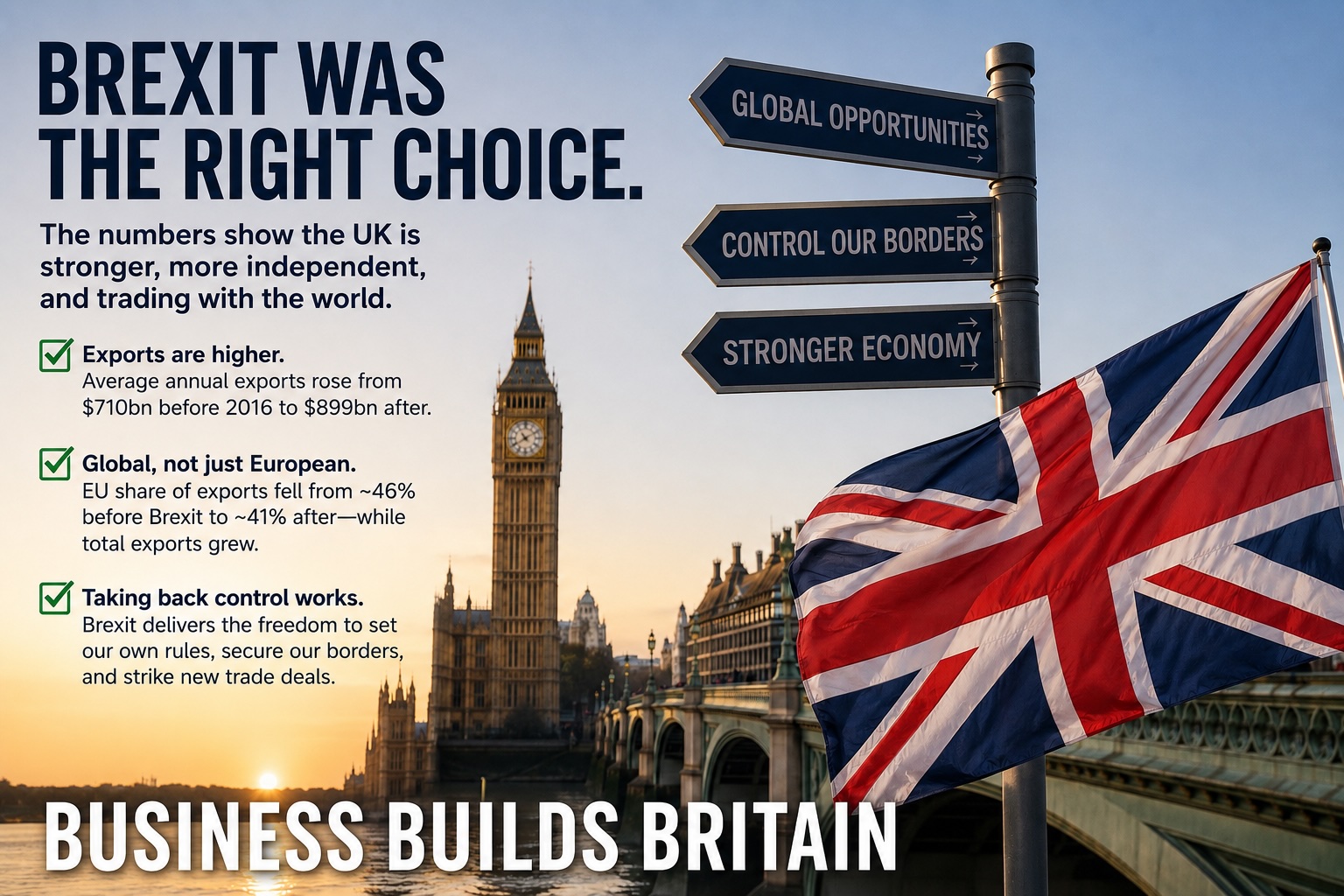
Average annual UK exports before the referendum stood at approximately $710 billion. In the decade following the vote, that figure rose to roughly $899 billion per year, despite the severe disruption caused by the COVID-19 pandemic. While critics often highlight individual trade frictions, the broader picture suggests that Britain retained its position as a major global trading nation outside the EU.
Before Brexit, approximately 46% of UK exports went to the European Union. In the years following Brexit, that proportion declined to around 41%, reflecting a diversification of British trade toward global markets beyond Europe. At the same time, total exports still increased overall in monetary value, particularly in services such as finance, technology, legal expertise, and consulting.
Imports also followed a similar pattern. Average annual UK imports rose from approximately $820 billion before Brexit to around $1.01 trillion afterward. Prior to Brexit, around 53–55% of imports came from the EU, whereas post-Brexit this reduced to approximately 48–50%. Although the EU remained Britain’s largest trading partner, the UK increasingly sourced goods and services from the United States, Asia, and emerging international markets.
Supporters of closer EU alignment, including Wes Streeting and Andy Burnham, have increasingly argued for rebuilding stronger institutional ties with Europe, while critics suspect Sir Keir Starmer’s government is gradually steering Britain back toward EU structures. Much of the political argument now centres on practical inconveniences such as passport queues, travel friction, and mobility restrictions. These concerns are genuine, but they are relatively minor when weighed against the constitutional issue that motivated many Brexit voters: democratic accountability and the right for the UK Parliament to control laws, borders, and trade policy independently.
Brexit has not been without shortcomings. Smaller exporters have faced additional bureaucracy, some industries experienced labour shortages, and trade with the EU became administratively more complex. However, opponents often overlook that the UK economy simultaneously expanded service exports, strengthened trade relationships beyond Europe, and demonstrated resilience during one of the most difficult global economic periods in generations.
The central Brexit argument was never simply about convenience. It was about sovereignty, national decision-making, and long-term flexibility. Measured against those objectives, and alongside the continued strength of UK exports and imports, there remains a strong case that leaving the European Union was the correct decision for Britain.
About the Author
Adrian Hawkins OBE was awarded his honour by the Queen in the 2021 New Years Day Honours list for his services to business and skills. A lifetime businessman, Adrian Chairs biz4Biz a business support organisation which he founded 15 years ago to create a business network initially in the Home Counties and which is now reaching further nationally. Adrian is also, Chairman of Hertfordshire Futures (previously the LEP) and the Hertfordshire Futures Skills and Employment Board. Adrian is also Chairman of the Stevenage Development Board alongside biz4Biz. Adrian has 50 years’ experience in the world of business.

ADRIAN HAWKINS OBE
Chairman – biz4Biz
Chairman – Hertfordshire Futures Board
Chairman – Stevenage Development Board
Chairman – Hertfordshire Skills & Employment Board