For fourteen years I have had the privilege of supporting Hertfordshire’s Local Enterprise Partnership (LEP), working alongside outstanding business leaders, local authorities, universities, colleges and government departments to drive economic growth across one of the UK’s most successful counties. Today, as Chair of Hertfordshire Futures, that work continues through its integration into Hertfordshire County Council. The name has changed, but the mission remains the same: creating opportunity, supporting business and delivering prosperity for our communities.
That is why the decision to abolish Local Enterprise Partnerships remains so difficult to understand.
LEPs were never designed to be political organisations. They were created to provide a direct connection between government and the businesses that create wealth, employment and innovation. They brought together people who understood local economies, local opportunities and local challenges far better than officials sitting hundreds of miles away in Whitehall.
Across Hertfordshire, that partnership model delivered exceptional results. Businesses, education providers and public sector organisations worked together to improve skills, attract investment, support innovation, strengthen infrastructure and help thousands of businesses grow. The county became one of the UK’s leading economic performers because decisions were increasingly shaped by those with first-hand knowledge of the local economy.
The principle was simple but powerful: those closest to the economy are usually best placed to identify what it needs.
Britain remains one of the most centralised countries in the developed world, with far too many important decisions controlled from Westminster. Successive governments have recognised this problem and spoken passionately about devolution, yet meaningful power has often remained firmly held at the centre.
The challenge has never been a shortage of capable local leadership. It has been the tendency of national governments to continually reorganise institutions before they have been given sufficient time to mature. Regional Development Agencies were abolished. LEPs followed. New structures emerged. Valuable expertise was dispersed, relationships had to be rebuilt, and institutional knowledge was repeatedly lost. Businesses value certainty, consistency and long-term thinking. Constant restructuring achieves the opposite.
Thankfully, Hertfordshire has largely avoided losing that expertise. Through Hertfordshire Futures, we have retained the partnership between business and local government that made the LEP successful in the first place. Business remains at the heart of economic decision-making while benefiting from closer integration with the County Council and its wider public services.
This evolution demonstrates that successful organisations should be strengthened rather than discarded.
If Britain is serious about improving productivity, attracting investment and creating sustainable growth, local leadership must be trusted with greater responsibility. National government should establish the framework and provide resources, but local economic priorities should be shaped by those who understand their places best.
The lesson from Hertfordshire is clear. Long-term partnerships between business, education and government deliver results. They build confidence, attract investment and create lasting prosperity. The objective should never be to continually reinvent the machinery of economic development, but to give successful local partnerships the stability, powers and confidence to deliver over decades rather than political cycles.
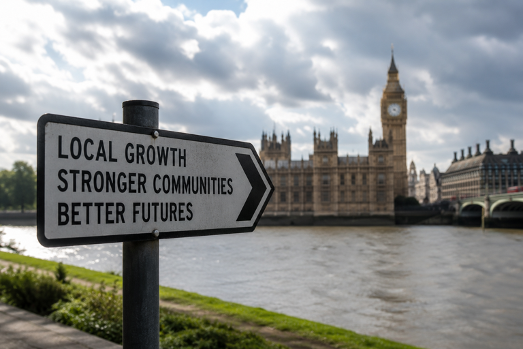
Economic growth is not created in Whitehall. It is created in our towns, cities, businesses and communities. The role of government should be to empower those places—not repeatedly reorganise them. Hopefully this will be where Andy Burnham MP PM places his support.
About the Author
Adrian Hawkins OBE was awarded his honour by the Queen in the 2021 New Years Day Honours list for his services to business and skills. A lifetime businessman, Adrian Chairs biz4Biz a business support organisation which he founded 17 years ago to create a business network initially in the Home Counties and which is now reaching further nationally. Adrian is also, Chairman of Hertfordshire Futures (previously the LEP) and the Hertfordshire Futures Skills and Employment Board. Adrian is also Chairman of the Stevenage Development Board alongside biz4Biz. Adrian has 50 years’ experience in the world of business.

ADRIAN HAWKINS OBE