The United Kingdom rightly prides itself on being one of the world’s oldest democracies. Universal suffrage was not gifted lightly; it was earned over generations through sacrifice, reform and the belief that every citizen should have a voice in shaping the nation’s future.
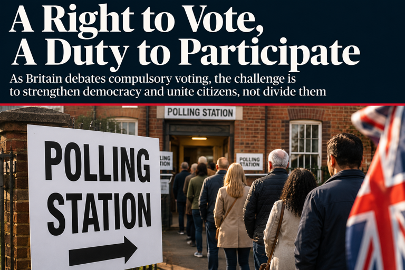
Yet democracy is not standing still. Falling electoral turnout, declining trust in politics and increasing polarisation have left many questioning whether our electoral system still serves the country as well as it should. The proposals reportedly being considered by Andy Burnham’s advisers—including compulsory voting, a modest £10 fine for non-voters and a “None of the Above” option—deserve serious debate rather than instinctive rejection.
Australia demonstrates that compulsory voting can work. Since introducing it in 1924, turnout has consistently exceeded 90 per cent. Governments enjoy stronger mandates, extreme political movements struggle to dominate elections through motivated minorities alone, and parties are encouraged to speak to the whole electorate rather than simply mobilising their core supporters.
Britain should certainly learn from that experience.
Automatic voter registration expanded postal and early voting, stronger civic education in schools and a legally recognised “None of the Above” option would all modernise our democratic process while preserving individual freedom of political expression.
However, if voting becomes a civic duty, should civic responsibility extend further?
There is a legitimate debate over whether those who deliberately reject the social contract should continue to exercise every democratic right without restriction. Most convicted prisoners already lose the right to vote while serving custodial sentences, reflecting society’s judgement that serious criminal offending carries consequences beyond imprisonment.
Beyond that, reform becomes considerably more difficult.
Some argue that long-term welfare recipients who make no contribution through employment should also lose voting rights. While superficially attractive to some, such an approach would create profound problems. Many people receiving long-term benefits are disabled, caring for relatives, recovering from illness or simply unable to find suitable work. Citizenship has never been contingent on income, and governments make decisions that affect every citizen, regardless of their employment status.
A better question may be whether Britain should do more to encourage contribution rather than punish dependency.
Those capable of working could be offered stronger incentives and clearer expectations to participate in employment, training, volunteering or community service. Democracy flourishes when citizens feel they have both a stake in society and an opportunity to shape it.
Perhaps the most important lesson from Australia is not compulsory voting itself, but the principle that democracy is both a right and a responsibility.
Britain should seize this opportunity to modernise its electoral system. Compulsory participation, easier access to voting, automatic registration, civic education, secure voter identification and a “None of the Above” option could collectively strengthen public confidence. At the same time, government must pursue policies that encourage every citizen to contribute to society wherever they are able.
Democracy is strongest not when the greatest number simply cast a ballot, but when the greatest number have a genuine stake in the nation’s success. Rights and responsibilities should never be seen as competing ideals. They are the twin foundations upon which every enduring democracy is built.
About the Author
Adrian Hawkins OBE was awarded his honour by the Queen in the 2021 New Years Day Honours list for his services to business and skills. A lifetime businessman, Adrian Chairs biz4Biz a business support organisation which he founded 17 years ago to create a business network initially in the Home Counties and which is now reaching further nationally. Adrian is also, Chairman of Hertfordshire Futures (previously the LEP) and the Hertfordshire Futures Skills and Employment Board. Adrian is also Chairman of the Stevenage Development Board alongside biz4Biz. Adrian has 50 years’ experience in the world of business.

ADRIAN HAWKINS OBE