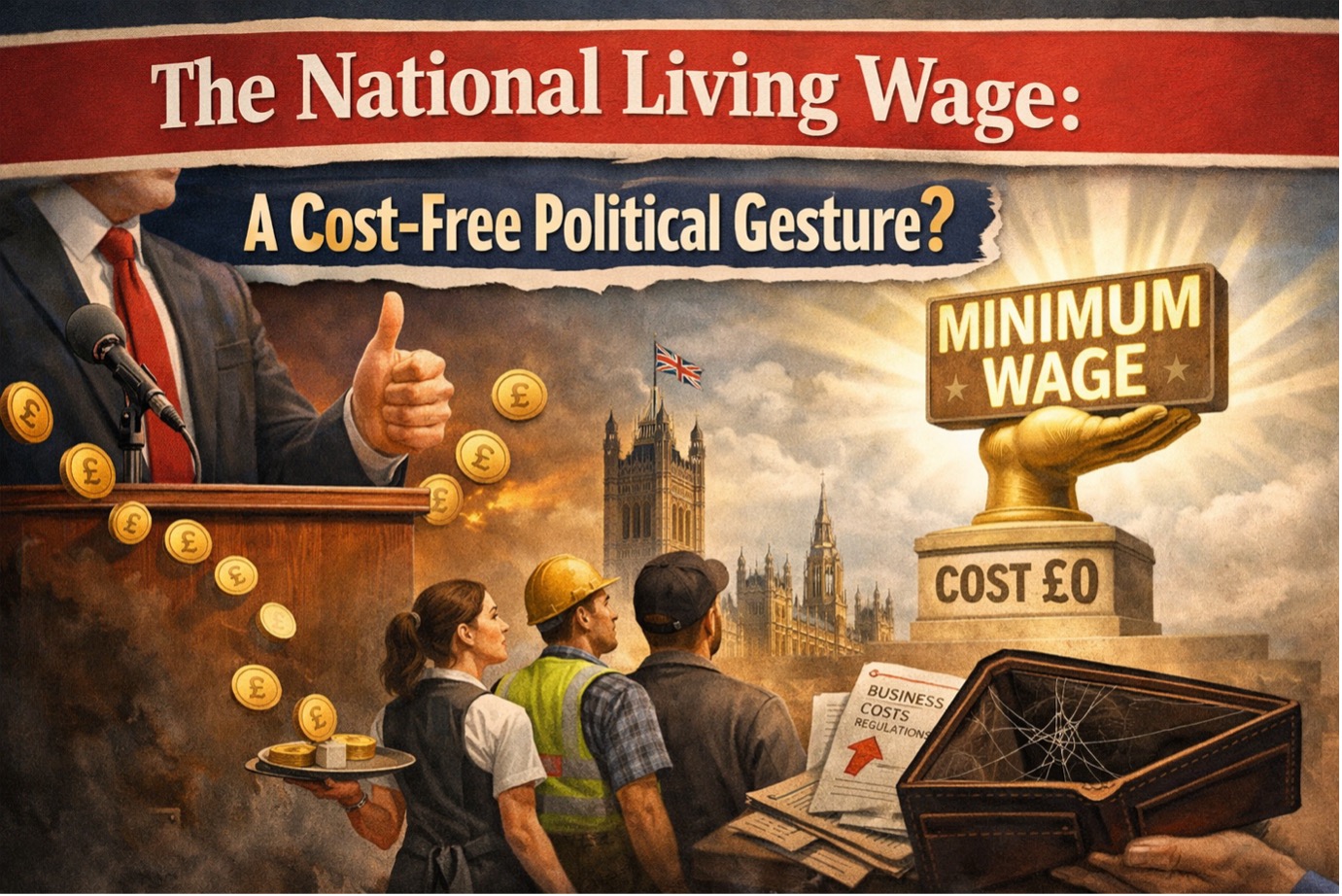
The annual announcement of the UK’s National Living Wage has become a familiar political ritual: a headline-grabbing figure, a promise of fairness, and a reaffirmation that government is “on the side of working people.” Yet, placed in proper perspective, these yearly adjustments reveal as much about political incentives as they do about economic necessity.
The minimum wage was first introduced in 1999 on the 1st of April and the rate set at that time was £3.60 per hour which, in real value terms should be £7.20 per hour today, but from the 1st of April 2026 is now £12.21 per hour.
At its core, raising the minimum wage is one of the few policies that allows governments to project action without directly spending public money. Unlike large-scale public investment or tax reform, increasing the wage floor shifts the burden onto employers. For ministers, this creates an appealing dynamic: they can claim credit for improving living standards while avoiding immediate fiscal cost. In a political environment where budgets are constrained and scrutiny is intense, this is a low-risk, high-visibility intervention.
However, the question remains: what framework determines these annual increases? Officially, the government relies on recommendations from the Low Pay Commission, which draws on labour market data, economic forecasts, and consultation with businesses and unions. In theory, this is a technocratic, evidence-based process balancing wage growth with employment stability. Metrics such as median earnings, productivity trends, and inflation all play a role.
In practice, the picture is less clear-cut. The headline ambition in recent years—to raise the National Living Wage to a set percentage of median earnings—has introduced a more politically defined target. While this provides a simple benchmark, it is not a law of economics. Median earnings themselves fluctuate with broader conditions, and tying minimum wage policy to them risks circularity: the benchmark moves as the outcome changes. Moreover, productivity growth—the traditional anchor for sustainable wage increases—has remained relatively weak in the UK. This raises legitimate questions about how far wage floors can rise without unintended consequences for hiring, hours, or prices.
The timing and presentation of these announcements also suggest a strong political dimension. Annual increases are often framed as evidence of a government delivering tangible benefits to “working families,” a phrase that resonates across electoral demographics. Yet the reality is more nuanced. Not all workers benefit equally; younger workers, the self-employed, and those in insecure employment may see little direct impact. Meanwhile, businesses—particularly small firms—absorb higher labour costs, which can feed through into higher prices or reduced staffing flexibility.
None of this is to argue that minimum wage increases are misguided. On the contrary, the UK’s wage floor has risen significantly in real terms since its introduction, contributing to reduced extreme low pay. But the simplicity of the policy can obscure its limits. It does not address deeper structural issues such as regional inequality, housing costs, or stagnant productivity. Nor does it substitute for a broader economic strategy.
Ultimately, the National Living Wage sits at the intersection of economics and politics. It is informed by data but shaped by narrative. It improves incomes for many, but at a cost borne elsewhere in the system. And while governments present each increase as a decisive intervention, it is also a reminder of how much of economic life remains beyond the reach of annual announcements.
About the Author
Adrian Hawkins OBE was awarded his honour by the Queen in the 2021 New Years Day Honours list for his services to business and skills. A lifetime businessman, Adrian Chairs biz4Biz a business support organisation which he founded 15 years ago to create a business network initially in the Home Counties and which is now reaching further nationally. Adrian is also, Chairman of Hertfordshire Futures (previously the LEP) and the Hertfordshire Futures Skills and Employment Board. Adrian is also Chairman of the Stevenage Development Board alongside biz4Biz. Adrian has 50 years’ experience in the world of business.

ADRIAN HAWKINS OBE
Chairman – biz4Biz
Chairman – Hertfordshire Futures Board
Chairman – Stevenage Development Board
Chairman – Hertfordshire Skills & Employment Board