

AI is changing who UK businesses hire, and for what. New job titles are appearing on organisation charts that did not exist five years ago, from Prompt Engineers to Chief AI Officers. The World Economic Forum’s Future of Jobs Report 2025 ranks Artificial Intelligence (AI) and Machine Learning (ML) Specialists among the fastest-growing roles worldwide. At home, the UK government’s AI Opportunities Action Plan (January 2025) has set a national target to scale AI capability and talent at pace.
Why UK Businesses Are Creating New AI Roles
Three forces are driving the shift.
The first is investment and sector growth. The UK government’s AI Sector Study identifies more than 3,000 active AI companies in the UK, generating around £10 billion in AI-related revenues. With AI named as a strategic growth sector, UK businesses will increasingly compete with the public sector and well-funded scale-ups for the same talent.The second is adoption. McKinsey’s State of AI 2025 finds that 78 percent of organisations now use AI in at least one business function. The leaders in that group are appointing dedicated AI leaders and creating new roles inside business units, not just inside IT.
The third is regulation. The UK has set out a pro-innovation, principles-based approach to AI, coordinated across regulators such as the ICO, FCA, and CMA. Any UK business selling into the EU also falls under the EU AI Act. Together with the international standard ISO/IEC 42001 (certified in the UK through BSI, NQA, LRQA, SGS, DNV and other UKAS accredited bodies), these rules have turned AI governance into a defined business function, with named roles, budgets, and reporting lines.
The Emerging AI Job Titles to Know
AI roles fall into three groups: people who build AI, people who apply it inside the business, and people who govern it. The table below lists the most common emerging titles in each group.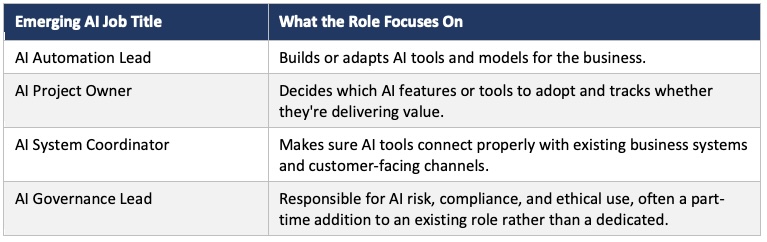
Putting AI to work in the business, and keeping it in check
For most small and medium-sized businesses, this is where things are growing fastest, and it’s also where owners often don’t realise just how much is changing. New roles are popping up to manage AI day to day. Someone needs to own how AI tools are being used and whether they’re delivering results. Someone needs to write and refine the instructions that make these tools work well, a job that barely existed a few years ago. And someone needs to make sure AI tools, data, and existing systems all fit together properly. Other people might focus purely on how customers experience chatbots or AI assistants.
None of this requires a computer science degree. It’s mostly about good judgement and understanding the business, which is exactly why SMEs can often fill these roles by upskilling existing staff rather than hiring expensive specialists.
At the same time, new rules and regulations mean businesses need someone keeping an eye on the risks, making sure AI is used responsibly, safely, and legally. Larger companies are hiring a dedicated Chief AI Officer for this. Most SMEs won’t need to go that far, but it’s worth making sure someone on the team is clearly responsible for AI governance, even if it’s just one part of their existing job.
AI Ethics and Responsible AI Leads embed fairness and transparency into how AI is built. AI Governance and Compliance Managers align AI use with ISO/IEC 42001 (standard for establishing, implementing, and continually improving an Artificial Intelligence Management System), and the ICO’s guidance on AI and data protection. AI Auditors provide independent assurance.
What This Means for Your Business
For the executive team: AI talent strategy is now part of business strategy. The UK government’s AI Opportunities Action Plan signals a national push that will tighten the labour market further. Decide which AI capabilities to own and which to buy, and sequence the build, apply, and govern hires in that order. If you operate in a regulated sector or sell into the EU, budget for at least one named AI risk role within the next 12 months.
For HR and talent leaders: Stop treating AI as a single skill. Build distinct hiring tracks for each of the three groups above, and link them to existing pay bands and career ladders. The WEF reports that 85 percent of employers plan to prioritise workforce upskilling by 2030, and that 39 percent of workers’ core skills will change in the same period. Internal pathways are cheaper than open-market hiring, and faster.
For employees: Build a visible portfolio that shows you have used AI to solve a real business problem. Industry certifications from AWS, Microsoft, Google, and IBM map to specific role families, and BCS, BSI, ISACA, and IAPP all offer UK-recognised AI governance and audit credentials aimed at the new risk roles.
Conclusion
The rise of AI careers is not one trend but three: a deeper technical core, a fast-growing layer of applied AI roles, and an entirely new AI risk and governance profession. With the UK government targeting AI as a strategic growth sector, competition for this talent will only intensify. The question for UK business leaders is no longer whether AI will reshape your workforce, but which of these three AI job families belongs on your org chart first, and what it will cost to get there ahead of your competitors.
Further information
- AI Opportunities Action Plan — Department for Science, Innovation and Technology (UK), January 2025.
- The Future of Jobs Report 2025 — World Economic Forum, January 2025.
- The State of AI: How organizations are rewiring to capture value — McKinsey & Company, 2025.
About the Author
Othman Rafay is a Cybersecurity Consultant and Advisor managing enterprise risk across the public and private sectors. His track record includes directing security strategies and corporate alignment for FTSE 100 and NYSE corporations, routinely advising C-suite executives and senior management on transforming digital threats into commercial business metrics. Additionally, he provides governance and board-level oversight for SMEs in Non-Executive Director (NED) and Board Observer capacities.

OTHMAN RAFAY
Associate