
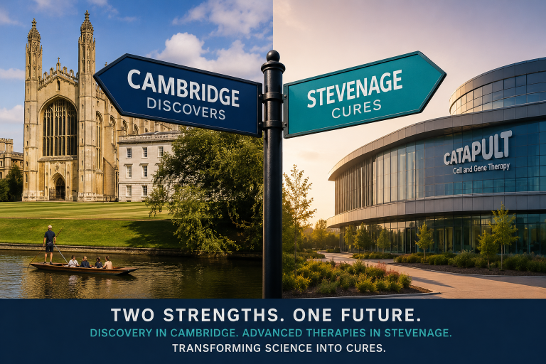
Cambridge will continue to discover tomorrow’s medicines. Hertfordshire could help deliver tomorrow’s cures. Britain’s Life Sciences Strategy must recognise the difference.
GSK’s announcement of a £400 million investment in a new global Research and Development centre on the Cambridge Biomedical Campus is welcome news. It reinforces Britain’s standing as a world leader in pharmaceutical research and confirms Cambridge’s position as one of the most important centres of biomedical discovery anywhere in the world.
The investment will bring together more than 1,000 scientists within one of Europe’s largest biomedical campuses, surrounded by internationally renowned universities, teaching hospitals, biotechnology companies and artificial intelligence specialists. Few locations can rival Cambridge’s ability to generate scientific discovery.
Yet the announcement also highlights a strategic question that Britain cannot afford to ignore.
Are we investing as confidently in the future of medicine as we are in its past?
For more than a century, pharmaceutical companies have transformed healthcare through medicines manufactured for millions of patients. Antibiotics, vaccines, cardiovascular drugs and cancer treatments have extended life expectancy across the globe and remain fundamental to modern medicine.
However, medicine is entering a fundamentally different era.
Increasingly, the greatest breakthroughs will not come from developing another medicine designed for the masses. They will come from therapies created for individual patients using their own cells or genetic material to correct the underlying cause of disease itself.
This is not simply the next chapter of pharmaceutical development. It represents a different application of medical science.
Traditional pharmaceuticals largely manage disease, control symptoms or slow progression. Cell and Gene Therapies increasingly seek to repair, replace or reprogramme the body’s own biological systems, offering the possibility of long-term remission and, in some cases, genuine cures for conditions that conventional medicines have never been able to overcome.
One only has to look at Autolus, established in Stevenage, whose pioneering CAR-T cell therapies harness a patient’s own immune cells to fight certain forms of leukaemia. For patients who had exhausted conventional treatment options, this technology has demonstrated that personalised medicine can achieve outcomes that traditional pharmaceuticals alone could not.
This is precisely why Hertfordshire deserves greater national recognition.
Over the past decade, Stevenage has quietly become one of the world’s leading centres for Cell and Gene Therapy. The Cell and Gene Therapy Catapult, Stevenage Bioscience Catalyst and an expanding community of advanced biotechnology companies have created one of the most sophisticated ecosystems for developing, manufacturing and commercialising personalised therapies anywhere in Europe.
Confidence in Hertfordshire’s future extends beyond Stevenage.
The opening of Hertfordshire Medical School at the University of Hertfordshire this September, the county’s first medical school, will help develop the future workforce needed by the NHS while strengthening capacity for health and social care research and innovation.
This builds on the University of Hertfordshire’s established strengths in teaching, research and enterprise across health, social care and the life sciences, supporting advances in patient outcomes and delivering benefits for local communities.
The University has long-standing strategic partnerships across the county, including with the Cell and Gene Therapy Catapult and Stevenage Bioscience Catalyst, and works closely with innovative businesses such as ImmuONE, the Stevenage-based biotech company, that transforms cutting-edge academic research into real-world solutions for industry clients.
Through partnerships with organisations including North Hertfordshire College in Stevenage, the University is also creating clear progression routes into careers in the life sciences sector, supporting a diverse and highly skilled future workforce.
Alongside this, the University’s £103 million Health Innovation Campus, opening in 2028, will create world-class facilities for educating healthcare professionals, advancing medical research and strengthening collaboration between universities, the NHS and industry.
These are not isolated investments.
Together they demonstrate that Hertfordshire is becoming a nationally significant centre where education, research, advanced manufacturing, clinical practice and commercial innovation converge to shape the future of healthcare.
This should not become a debate about Cambridge versus Hertfordshire.
Cambridge excels in scientific discovery. Hertfordshire is increasingly demonstrating how those discoveries can be translated into advanced therapies, commercial manufacturing and life-changing patient treatments.
Together they create a complete innovation pathway—from laboratory discovery to personalised cure.
Government’s forthcoming Life Sciences Strategy should therefore look beyond individual locations and recognise the emergence of a Cambridge–Hertfordshire Life Sciences Corridor. Such a partnership would combine one of the world’s greatest centres of scientific discovery with one of the world’s most exciting centres for advanced therapies and healthcare innovation.
Britain’s ambition should not simply be to discover more medicines.
It should be to lead the world in developing treatments that eliminate disease altogether.
If Cambridge helps discover tomorrow’s science, Hertfordshire is increasingly showing how Britain can transform that science into cures.
That is the future of medicine—and it is a future Britain must choose to lead.
About the Author
Adrian Hawkins OBE was awarded his honour by the Queen in the 2021 New Years Day Honours list for his services to business and skills. A lifetime businessman, Adrian Chairs biz4Biz a business support organisation which he founded 17 years ago to create a business network initially in the Home Counties and which is now reaching further nationally. Adrian is also, Chairman of Hertfordshire Futures (previously the LEP) and the Hertfordshire Futures Skills and Employment Board. Adrian is also Chairman of the Stevenage Development Board alongside biz4Biz. Adrian has 50 years’ experience in the world of business.

ADRIAN HAWKINS OBE