
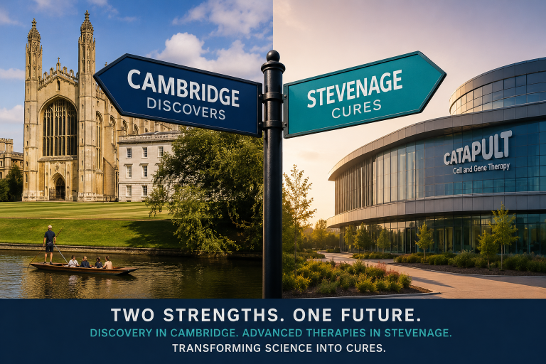
GSK’s decision to invest £400 million in a flagship research centre on the Cambridge Biomedical Campus confirms Britain’s position as one of the world’s leading centres for pharmaceutical research. Cambridge deserves that recognition. Its universities, hospitals and research institutes have helped shape modern medicine for generations.
Yet the announcement also exposes a far more important question. Is Britain investing as confidently in the future of medicine as it is in its past?
Traditional pharmaceutical research has transformed healthcare. Mass-produced medicines have eradicated diseases, prolonged life expectancy and improved the quality of life for billions of people. They will continue to play a vital role in treating chronic illness, infection and countless medical conditions.
However, medicine is undergoing a fundamental transition.
Many of tomorrow’s greatest breakthroughs will not come from developing another tablet or injectable medicine designed for millions of identical patients. They will come from therapies created specifically for one individual, using that person’s own cells or genetic material to eliminate diseases that conventional pharmaceuticals have never been able to cure.
This is not simply an evolution of pharmaceutical science. It is an entirely different application of medical science.
Cell and Gene Therapies do not merely manage disease; increasingly, they seek to correct or replace the underlying biological cause. Instead of slowing illness, they offer the prospect of long-term remission and, in some cases, genuine cures.
Stevenage has become one of the world’s leading centres for this revolution.
The Cell and Gene Therapy Catapult, Stevenage Bioscience Catalyst and an internationally respected community of biotechnology companies have created capabilities that few countries possess. Here, personalised therapies are being developed, manufactured and commercialised at scale.
Perhaps the clearest example is Autolus. Established in Stevenage, the company has pioneered CAR-T cell therapies that re-engineer a patient’s own immune cells to attack certain blood cancers. For patients with forms of leukaemia who had exhausted conventional treatment options, this technology has demonstrated that diseases once regarded as incurable can, in some cases, be driven into remission through personalised medicine rather than conventional pharmaceutical intervention.
That represents more than scientific progress. It represents a change in philosophy.
Britain should not view Cambridge and Stevenage as competitors. Cambridge remains one of the world’s great centres of biomedical discovery. Stevenage is becoming one of the places where medicine itself is being redefined.
If our national strategy focuses primarily on traditional pharmaceutical discovery while underestimating advanced therapies, we risk investing disproportionately in yesterday’s industrial model while other nations seize leadership in tomorrow’s.
The next century of medicine will not be measured simply by how many new drugs we discover. It will be measured by how many diseases we no longer need drugs to manage because personalised therapies have learned how to cure them.
That is the opportunity Britain cannot afford to overlook.
About the Author
Adrian Hawkins OBE was awarded his honour by the Queen in the 2021 New Years Day Honours list for his services to business and skills. A lifetime businessman, Adrian Chairs biz4Biz a business support organisation which he founded 17 years ago to create a business network initially in the Home Counties and which is now reaching further nationally. Adrian is also, Chairman of Hertfordshire Futures (previously the LEP) and the Hertfordshire Futures Skills and Employment Board. Adrian is also Chairman of the Stevenage Development Board alongside biz4Biz. Adrian has 50 years’ experience in the world of business.

ADRIAN HAWKINS OBE