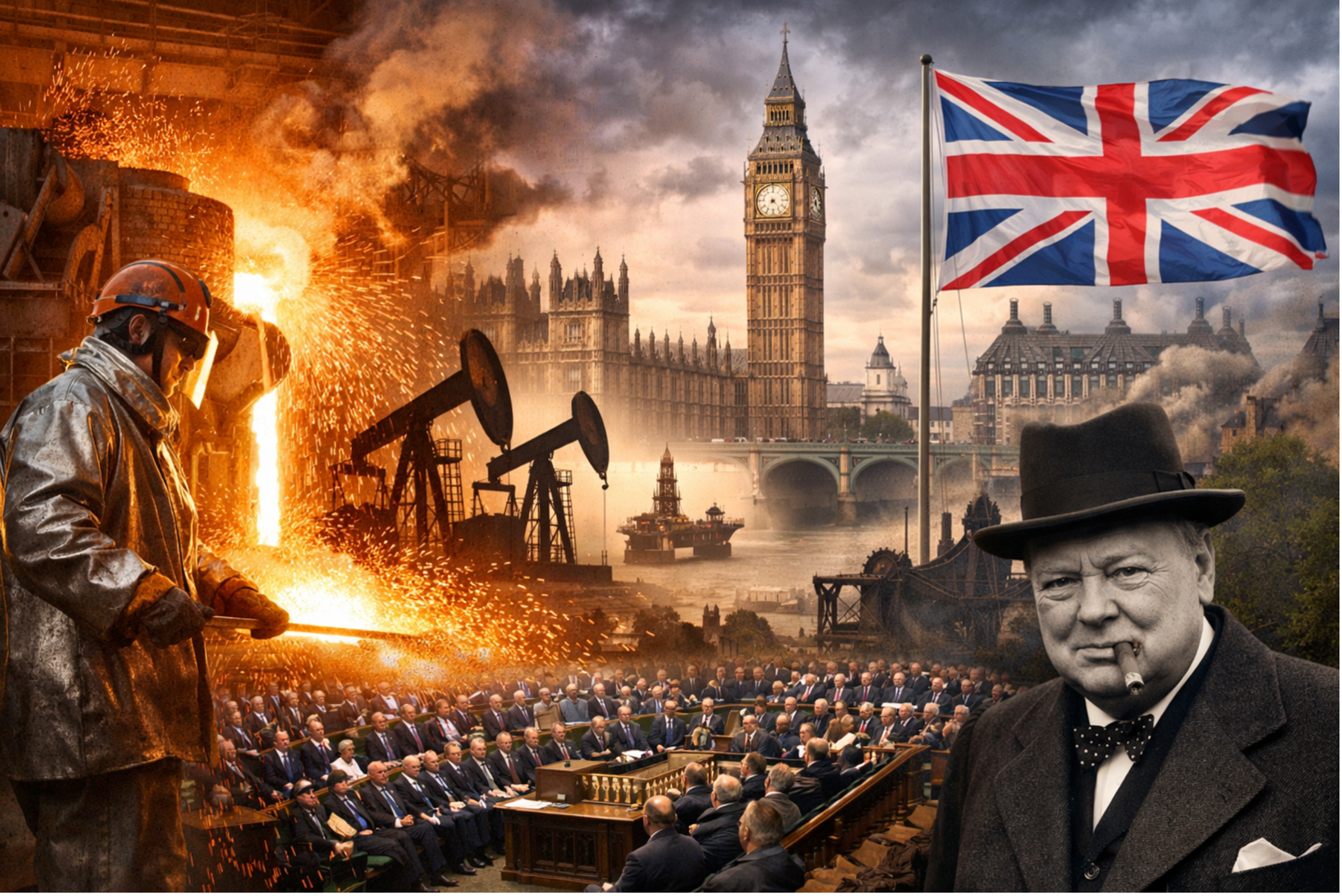
“The United States was the greatest industrial Power in the world, and we were the second. Germany was only the third.”
— Winston Churchill, Their Finest Hour
Churchill’s reflection was not a boast—it was a strategic diagnosis. In 1940, with Britain standing alone, he understood that wars are not won merely by courage or tactics, but by furnaces, mills, and output. Steel was not just an industry; it was the bloodstream of national survival.
That is why Saturday sittings of Parliament matter. They are rare interruptions to constitutional routine, reserved for moments when the nation confronts something urgent, structural, and potentially irreversible. When Parliament is recalled on a Saturday, it is an admission that time has run out—that decisions deferred have become decisions forced.
The recent Saturday recall to address control of British steel places industrial capacity back where Churchill always believed it belonged: at the centre of national security. Steel underpins everything from defence procurement to infrastructure resilience. Without domestic capability, sovereignty becomes conditional—dependent on supply chains that may not hold under stress.
Yet this raises an uncomfortable question: why now?
The decline of British steelmaking has not been sudden. It has been visible for decades—through plant closures, foreign ownership, shrinking capacity, and rising energy costs. Successive governments have understood, at least in principle, that steel is strategic. And yet intervention has come only at the point of crisis, when blast furnaces face extinction and emergency legislation becomes necessary.
This pattern is not unique to steel. It echoes across energy policy. Coal was phased out with little regard for strategic reserve. Oil production in the North Sea has declined without a clear replacement framework. Gas storage has at times been reduced to minimal levels compared with European counterparts. In each case, long-term resilience has been subordinated to short-term economics or environmental positioning, only for vulnerabilities to emerge later under pressure.
The danger is not transition—it is unmanaged transition. A modern economy can decarbonise and still maintain strategic capacity. But that requires foresight, investment, and a willingness to treat certain industries not as market commodities, but as national assets.
Saturday sittings, then, are symptoms as much as solutions. They reveal a system that can act decisively—but often only when compelled by urgency. Churchill’s insight was that industrial strength must be cultivated before crisis, not improvised during it.
If steel has now been recognised as essential to UK security, the question is whether that lesson will be applied more broadly. Energy, like steel, is foundational. Without secure, scalable, and domestically anchored supply—whether in gas, electricity, or future fuels—the same vulnerabilities will reappear in different forms.
The real test is whether Britain moves from reactive intervention to strategic continuity. Otherwise, the Saturday recall risks becoming not an exception—but a pattern.
About the Author
Adrian Hawkins OBE was awarded his honour by the Queen in the 2021 New Years Day Honours list for his services to business and skills. A lifetime businessman, Adrian Chairs biz4Biz a business support organisation which he founded 15 years ago to create a business network initially in the Home Counties and which is now reaching further nationally. Adrian is also, Chairman of Hertfordshire Futures (previously the LEP) and the Hertfordshire Futures Skills and Employment Board. Adrian is also Chairman of the Stevenage Development Board alongside biz4Biz. Adrian has 50 years’ experience in the world of business.

ADRIAN HAWKINS OBE
Chairman – biz4Biz
Chairman – Hertfordshire Futures Board
Chairman – Stevenage Development Board
Chairman – Hertfordshire Skills & Employment Board