In recent years, the United Kingdom has experienced climatic extremes that are not random anomalies but part of a clear and scientifically verified long‑term trend. Official data show the UK is becoming warmer, that heatwaves and sunny periods are more frequent and intense than in the past, and that rainfall patterns are shifting in ways that affect society and the environment.
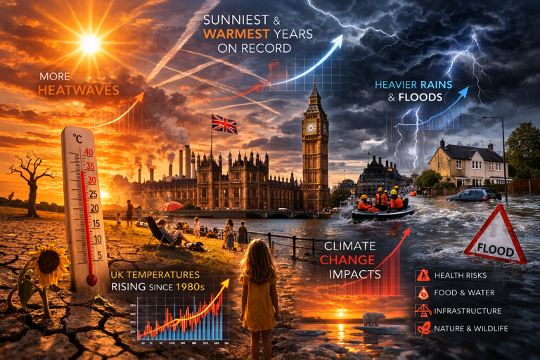
According to the Met Office, 2025 was provisionally the UK’s warmest and sunniest year on record, using long‑running national datasets. Sunshine records dating back to 1910 show totals exceeding previous benchmarks, reflecting elevated temperatures and prolonged sunny spells consistent with global warming trends.
The UK has warmed by approximately 0.25°C per decade since the 1980s. The most recent decade has been significantly warmer than the 1961–1990 baseline, and all of the ten warmest UK years in the instrumental record have occurred since 2003. Temperature extremes are increasing, with more days exceeding 28°C and 30°C than in mid‑20th century norms.
Heatwaves are becoming longer and more intense. Climate projections indicate that extremely hot days will become more common in coming decades, with temperatures exceeding 40°C potentially occurring more frequently in southern regions if global emissions continue at current trajectories.
Rainfall trends are more complex. While annual totals vary year to year, heavy rainfall events have increased in intensity and frequency, particularly in autumn and winter. A warmer atmosphere holds more moisture, increasing the risk of flooding and infrastructure stress.
The long‑term impacts are significant. Agriculture faces heat stress and drought risk. Water management must contend with both drought and flooding extremes. Health systems experience increased pressure during heatwaves. Transport, housing, and energy infrastructure must adapt to withstand temperature and rainfall extremes. Ecosystems are also under pressure as species struggle to adapt to rapidly changing conditions.
These observed changes are not the result of covert atmospheric interventions. They are consistent with well‑established scientific understanding of human‑driven climate change caused by rising greenhouse gas concentrations. The evidence from observational records, attribution studies, and climate modelling is robust and widely supported within the scientific community.
Adaptation and mitigation are therefore essential. Strengthening infrastructure resilience, improving flood defences, expanding heat‑health action plans, and accelerating emissions reductions will be critical to protecting communities and economic stability in the decades ahead.
Key Met Office Sources:
UK Climate – Climate change in the UK
State of the UK Climate Reports
2025 Warmest and Sunniest Year Announcement
Heavy Rainfall and Flooding Trends
About the Author
Adrian Hawkins OBE was awarded his honour by the Queen in the 2021 New Years Day Honours list for his services to business and skills. A lifetime businessman, Adrian Chairs biz4Biz a business support organisation which he founded 15 years ago to create a business network initially in the Home Counties and which is now reaching further nationally. Adrian is also, Chairman of Hertfordshire Futures (previously the LEP) and the Hertfordshire Futures Skills and Employment Board. Adrian is also Chairman of the Stevenage Development Board alongside biz4Biz. Adrian has 50 years’ experience in the world of business.

ADRIAN HAWKINS OBE
Chairman – biz4Biz
Chairman – Hertfordshire Futures Board
Chairman – Stevenage Development Board
Chairman – Hertfordshire Skills & Employment Board