Britain likes to say it wants to be a science superpower. In one Hertfordshire town, that ambition is no longer a slogan — it is a functioning reality.
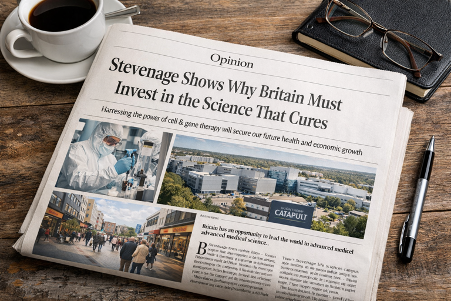
Stevenage, the first New Town built after the Second World War, has quietly become the UK’s most important centre for cell and gene therapy. Today it hosts the largest cluster of advanced therapies outside the United States, has attracted £3.2 billion of private-sector investment for Regeneration, and sits at the forefront of a medical revolution that promises not just better treatments, but actual cures.
This matters — not only for patients, but for the future of the British economy.
Cell and gene therapies are redefining medicine. Instead of managing disease over a lifetime, they aim to correct it at its source: repairing genes, reprogramming cells, and restoring function. They are already transforming outcomes in cancer, rare genetic disorders, and immune diseases. In time, they will reshape healthcare itself.
Stevenage is where much of this transformation is happening.
At the heart of the cluster sits the Cell and Gene Therapy Catapult, alongside the Stevenage Bioscience Catalyst and a growing network of global pharmaceutical firms, scale-ups, manufacturers, and research organisations. Together, they form something rare: a complete ecosystem that takes ideas from laboratory bench to clinical reality — and increasingly, to large-scale manufacturing.
This is not a speculative science park. It is an industrial engine already delivering.
The £3.2 billion invested by private capital is not a promise of future success; it is proof of market confidence today in the Town. Investors, manufacturers and global firms have already judged Stevenage — and by extension the UK — to be one of the best places in the world to develop advanced therapies.
That matters because private capital is selective. It flows to places with skills, infrastructure, regulatory credibility and long-term potential. When billions choose a location, government should take note.
Yet here lies the paradox. Britain has helped create a world-leading cluster — but now risks underinvesting in the very stage where the greatest value is captured.
Advanced therapies do not fail because the science is weak. They fail when promising discoveries cannot cross the so-called “valley of death” between clinical success and commercial scale. Manufacturing facilities are expensive. Clinical trials are complex. Workforce skills take years to build. Without patient, strategic public investment, the outcome is predictable: intellectual property developed in the UK is sold abroad, manufacturing happens elsewhere, and British patients wait longer for treatments invented on their doorstep.
This is not a hypothetical risk. It has happened many times before.
The economic case for avoiding that mistake is overwhelming. Life sciences investment consistently outperforms most other forms of economic development. Each pound invested typically generates £2.50 to £4 in economic output, supports high-value jobs with wages far above the national average, and creates export-intensive industries that strengthen the balance of trade let alone the huge savings to be made by the NHS
Crucially, even when individual companies fail — as some inevitably will — the knowledge, skills and platforms remain in the economy. Scientists move on. Manufacturing capability persists. Spillovers feed into diagnostics, artificial intelligence, robotics and digital health. Failure in life sciences still builds national assets.
There is also a case that rarely receives enough attention: the productivity of the NHS.
Britain’s health system faces relentless pressure from chronic disease, ageing demographics and rising costs. Cell and gene therapies change that equation. A one-off treatment that cures, or dramatically modifies, a disease can replace decades of repeat interventions, hospital admissions and social care. Over time, this is not just better medicine — it is better NHS economics.
Seen this way, investment in advanced therapies is not merely industrial policy. It is health-led productivity reform.
The lesson of the pandemic should sharpen the argument further. Covid-19 exposed the fragility of global supply chains and the strategic importance of domestic capability. Vaccines, diagnostics and therapeutics became instruments of national resilience. Advanced therapies deserve the same treatment.
If the UK loses leadership in cell and gene therapy, it does not simply lose companies. It loses clinical sovereignty — the ability to ensure that life-saving treatments are manufactured, regulated and deployed at home, for its own population.
Stevenage offers a rare chance to avoid that fate.
There is also a deeper symbolism at work. Stevenage was built after the war as part of a national effort to rebuild Britain — not just physically, but socially and economically. Today, it is doing so again, anchoring a post-industrial economy in science, skills and long-term value creation.
This is what regeneration looks like when it is done properly: not short-term subsidy, but sustained investment in capability that compounds over decades
So, what should government do?
First, recognise Stevenage for what it is: national infrastructure, not a regional project. Advanced therapies are as strategically important as energy grids or transport hubs.
Second, provide patient capital to support translation and scale-up, ensuring that companies can grow without selling their future abroad.
Third, invest in advanced manufacturing — facilities, workforce training and regulatory agility — so that the UK captures not just discovery, but production.
Fourth, use the NHS as an anchor customer, accelerating adoption pathways so that British patients benefit first from British science.
Above all, government must offer policy certainty. Advanced therapies operate on 10- to 15-year horizons. Frequent changes in incentives, funding regimes or regulatory direction deter exactly the kind of investment Britain needs.
None of this requires blind faith. The market has already spoken. The science is already working. The cluster already exists.
The choice now is whether the UK fully backs a sector that can deliver economic growth, health resilience and global leadership — or whether it allows that leadership to drift elsewhere.
Stevenage and Hertfordshire have shown what is possible when ambition meets execution. The only remaining question is whether Britain is prepared to invest in the cures it helped create — and in doing so, secure a more productive, healthier future for the whole Country and the World.
About the Author
Adrian Hawkins OBE was awarded his honour by the Queen in the 2021 New Years Day Honours list for his services to business and skills. A lifetime businessman, Adrian Chairs biz4Biz a business support organisation which he founded 15 years ago to create a business network initially in the Home Counties and which is now reaching further nationally. Adrian is also, Chairman of Hertfordshire Futures (previously the LEP) and the Hertfordshire Futures Skills and Employment Board. Adrian is also Chairman of the Stevenage Development Board alongside biz4Biz. Adrian has 50 years’ experience in the world of business.

ADRIAN HAWKINS OBE
Chairman – biz4Biz
Chairman – Hertfordshire Futures Board
Chairman – Stevenage Development Board
Chairman – Hertfordshire Skills & Employment Board