
There is a persistent myth in British politics that government funds public services, and business merely operates within that system. The fiscal reality is the reverse. The British state is structurally financed by private enterprise.
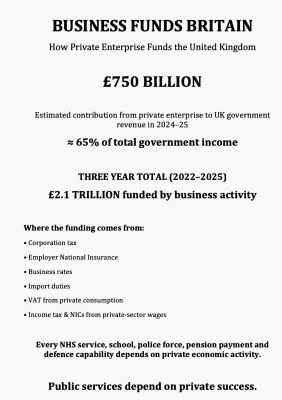
In the 2024–25 fiscal year, total UK government receipts were approximately £1.14 trillion. Of that, around £750 billion — roughly 65% — was generated directly or indirectly by private sector economic activity. Over the past three years combined, business activity has funded approximately £2.1 trillion of government income.
This is not an ideological claim. It is an accounting fact.
Start with direct business taxation. Companies pay corporation tax on profits. They pay employer National Insurance on every member of staff. They pay business rates on commercial premises. Import duties are paid by firms that bring goods into the country. In recent years, sector-specific levies — from banking to energy — have added further billions. Taken together, these direct business taxes account for roughly £250 billion per year.
But the story does not stop there.
Private enterprise also funds government through employment. Around 27 million people in the UK work in the private sector. The wages paid by businesses generate income tax and employee National Insurance contributions. After removing circular taxation from public sector wages — which is simply government paying itself — private sector employment generates roughly £300 billion per year in labour taxes alone.
Consumption is the third pillar. Businesses create goods and services. Consumers purchase them. Value Added Tax is collected at each stage of that commercial activity. Approximately £150 billion of VAT annually can be attributed to private consumption funded by private wages and profits.
Add to this fuel duty linked to commercial transport, capital gains taxes arising from business assets, and other transaction-based revenues, and the picture becomes clear: roughly two-thirds of all government income is rooted in private enterprise.
Every hospital funded, every school staffed, every police force deployed, every pension paid — all ultimately depend on business productivity, capital investment, innovation and risk-taking.
When economic growth slows, tax receipts fall. When businesses contract, the state’s revenues weaken. When investment rises, so does the government’s fiscal capacity. The link is direct and measurable.
This does not diminish the role of government. Public institutions provide stability, infrastructure, rule of law and services essential to civil society. But it does clarify the order of causation. Wealth must first be created before it can be redistributed.
For policymakers, the implication is straightforward. If the objective is sustainable public services and fiscal resilience, then the priority must be a competitive and stable business environment. Tax policy, regulation, planning, energy costs and capital markets are not peripheral technicalities — they are determinants of the state’s revenue base.
Business does not sit outside society. It funds it.
Britain’s prosperity and Britain’s public services are not competing interests. They are interdependent. A strong business community is not merely beneficial to the Treasury — it is the Treasury’s foundation.
Public services depend on private success. Private enterprise truly delivers Social Value and should be entirely proud as a result.
About the Author
Adrian Hawkins OBE was awarded his honour by the Queen in the 2021 New Years Day Honours list for his services to business and skills. A lifetime businessman, Adrian Chairs biz4Biz a business support organisation which he founded 15 years ago to create a business network initially in the Home Counties and which is now reaching further nationally. Adrian is also, Chairman of Hertfordshire Futures (previously the LEP) and the Hertfordshire Futures Skills and Employment Board. Adrian is also Chairman of the Stevenage Development Board alongside biz4Biz. Adrian has 50 years’ experience in the world of business.

ADRIAN HAWKINS OBE
Chairman – biz4Biz
Chairman – Hertfordshire Futures Board
Chairman – Stevenage Development Board
Chairman – Hertfordshire Skills & Employment Board